





ITESO Satellite Travels with NASA
- Inicio
ITESO Satellite Travels with NASA
A satellite designed by students, alumni, and professors from ITESO, in collaboration with the IPN and UNAM, has already completed three suborbital flights with NASA. It is expected to take off again in 2025.
Diana Alonso
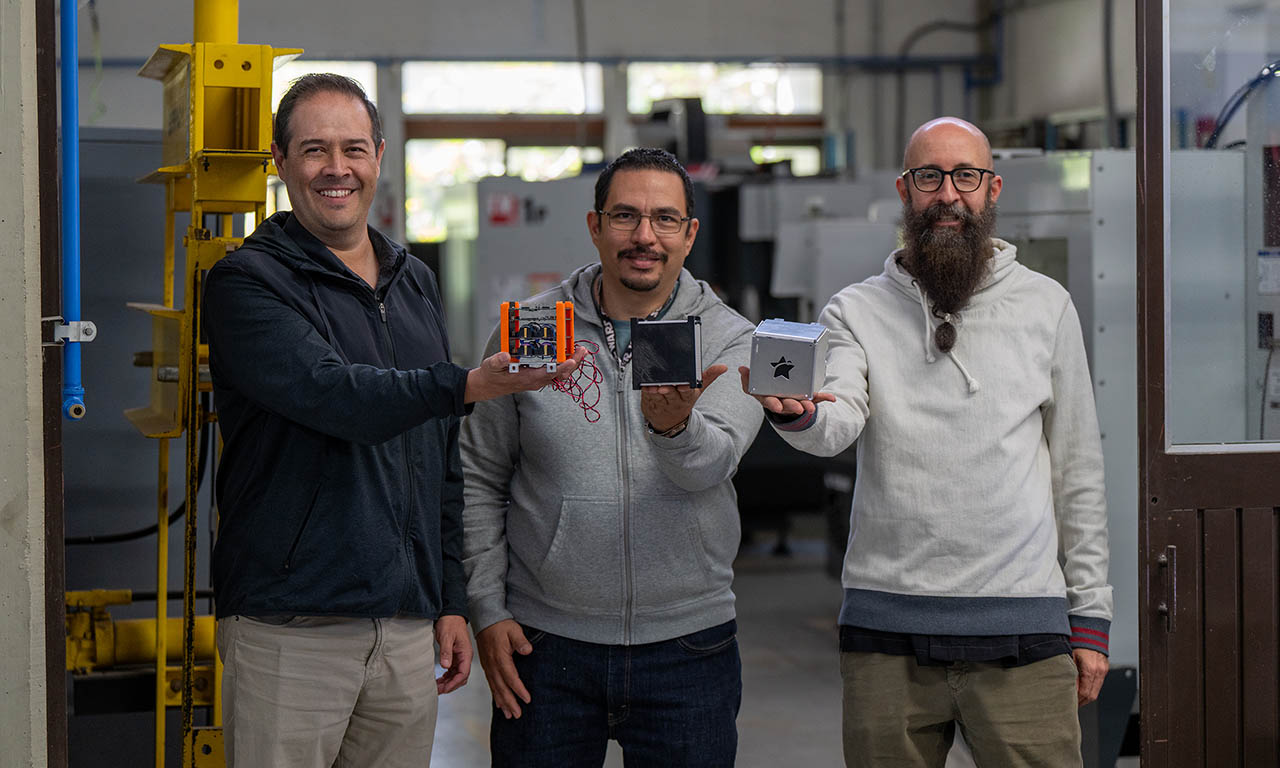
The ITESAT is a metal cube that fits on the palm of your hand. At first glance it seems small, but it can withstand the intensity of rising and falling from the stratosphere at more than 50 kilometers of altitude. Its components are the result of years of research, and it is capable of storing and transmitting environmental information from far above the Earth.
“We aim to develop space devices, such as satellites, with a specific mission. The first objective of the ITESAT is for it to be in orbit, with all its systems operating and for us to be able to communicate with it,” said Luis Rizo Domínguez, coordinator of the Graduate Certificate in Embedded Systems, who leads ITESO’s involvement in the project.
Its origin dates back to 2022, when students, alumni, and faculty from ITESO joined the Experimental Module for the Iterative Design of Satellite Subsystems project (EMIDSS), led by the National Polytechnic Institute (IPN), with the National Autonomous University of Mexico (UNAM) also participating.
The goal of this inter-university team is to develop technologies and conduct experiments at the boundary between the atmosphere and outer space — all under the rigorous standards and evaluations of NASA’s Scientific Balloon Program.
It was during the FY22-FTS mission that ITESO designed a flight computer capable of being reconfigured during the journey, as well as specialized software that allowed the EMIDSS-3 suborbital station to ascend and collect environmental data. A secondary payload was also carried to evaluate the performance of electronic devices under those conditions. This was the first step in the development of the ITESAT.
“Most devices operate between -20 and 60 degrees Celsius. Up there, they are exposed to -50 degrees Celsius and up to around 150 degrees Celsius. The atmospheric pressure is a vacuum. There is zero humidity, and the equipment is exposed to radiation. Here on Earth, the ozone layer protects us — it lets light through but not radiation particles. The impact of just one of those particles can burn out a transistor,” Rizo explained.
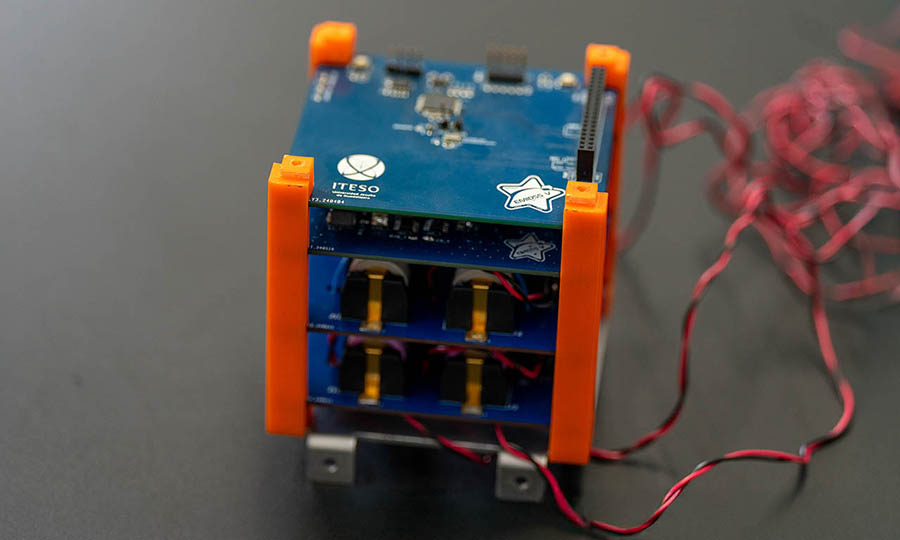
In 2023, an embedded system (a computing system whose components are integrated onto a single board or motherboard) was implemented, featuring an automotive-grade microprocessor provided by the company NXP. “An essential element is our connection with industry. We’ve also carried out tests with Continental,” he added. This provided additional support for the EMIDSS-4 module’s onboard computer, which, as in every mission, ascended thanks to a scientific balloon the size of a football stadium.
Becoming part of a NASA mission is no easy task, since the launch involves strict requirements: “Proposals are submitted in December. They approve them in February […], in March we run an iteration here on campus with the ITESAT. Then UNAM and IPN come to our labs in May and July. Another test is conducted at NASA, and finally, the launch takes place in early August.”
This sums up months of work and iterations — that is, repeated trial-and-error experiments to ensure the devices function properly during flight.
It wasn’t until 2024 that the CubeSat, ITESAT, reached the stratosphere — over 55 kilometers high — during the EMIDSS-5 module mission, traveling a distance of 330 kilometers. It was launched from NASA’s Fort Sumner station in New Mexico. Integrated into it were voltage regulation devices, environmental sensors capable of measuring ozone, methane, temperature, and GPS data. Its memory, structure, and new batteries were also tested.
“On one of the flights we noticed that the University of Virginia was using these tiny batteries. We realized they were the same ones used in vape devices,” he said cheerfully, noting that they turned out to be much cheaper than space-grade batteries.
Around 40 members of the university community collaborate on the project, including students from the Electronic, Mechanical, and Software Engineering programs; the Graduate Certificate in Embedded Systems; the Master’s in Electronic Design; as well as alumni from these same programs.
Rizo shared that the most recent flight was successful, and the entire team is looking forward to participating in the next mission with the EMIDSS-7 module this August, in which a transmitter with an 835-kilometer range will be integrated into the ITESAT.
“ITESO provides many laboratories and countless opportunities. It’s an open invitation to anyone who feels passionate about this field.”